CELLULAR MEDICAL DEVICESThe Connection Is Built
The Connection Is Built
Into the Device.
Digi Med Dev develops cellularly connected wearable medical devices that can sense, process, and transmit health data without depending on a patient's phone or home network.
Our first application is DigiBooBoo, a connected wound-monitoring system—and the technology behind it is being designed to extend far beyond a single device or sensor.
Sensor
Wearable
Cellular Network
Cloud
Clinician
The First Application
Starting With Wound Care
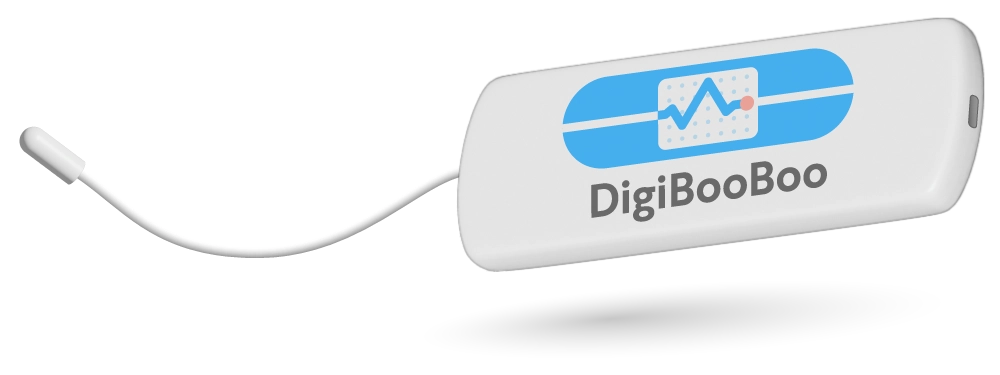
DigiBooBoo is the first medical product built on the Digi Med Dev architecture. It is a cellular-connected wound-monitoring system designed to continuously monitor wound-site skin temperature and provide clinicians with trend data and alerts without relying on patient technology.
- Continuous sensing
- The device collects frequent temperature readings and processes them locally.
- Direct cellular connectivity
- LTE-M / NB-IoT connectivity is built into the device.
- No patient phone required
- No Bluetooth pairing, app installation, or home Wi-Fi is required for normal operation.
- Connected clinical software
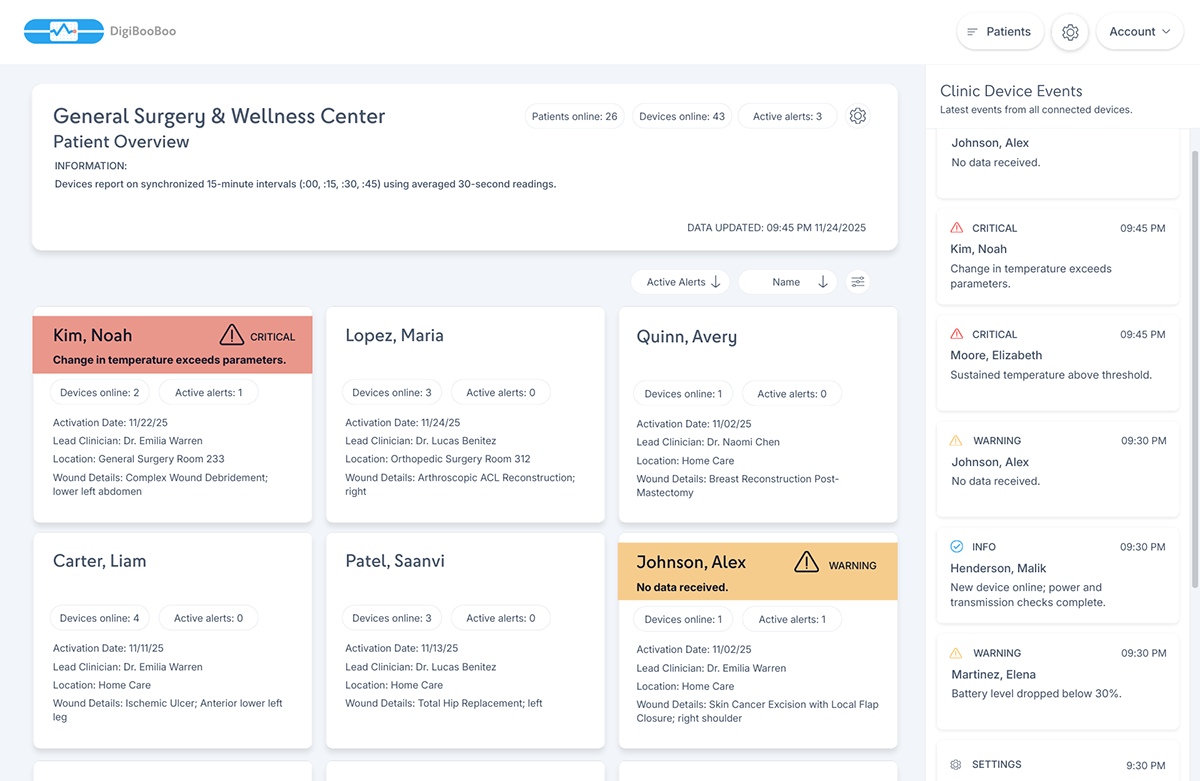
- Data feeds into a clinician-facing dashboard with trends, device status, events, and alert workflows.
Built for the Care Team
Continuous readings become trend data a care team can act on — not a stream of raw numbers.
DigiBooBoo is under development and is not a diagnostic device. Pending regulatory clearance.
Core Technology
More Than a Smart Bandage
DigiBooBoo required us to solve a much larger problem: how to build a wearable medical device that can sense, compute, communicate, recover from connectivity loss, manage its own power, securely transmit data, and remain visible to the care team.
Sensor
Temperature today. Other sensing technologies can be integrated for future applications.Cellular Wearable
Embedded processing, battery power, sensor interfaces, local storage, device identity, and direct cellular connectivity.Network
LTE-M / NB-IoT with multi-carrier capability and automatic reconnection.Cloud
Secure device ingestion, telemetry, data storage, APIs, and device management.Clinical Software
Dashboards, trends, events, alerts, acknowledgement, resolution, and device-health visibility.
Architecture
Built as a System. Designed as Components.
The technology developed for DigiBooBoo is increasingly being structured as reusable components rather than one tightly coupled product. That creates multiple paths forward: build new Digi Med Dev devices, integrate new sensors into the connected wearable, or potentially use selected parts of the stack independently in partner and OEM applications.
Cellular Wearable Core
Embedded Firmware
Connectivity
Cloud & Device Management
Dashboard
Alerts & Intelligence
What the Architecture Enables
- Digi Med Dev Sensor + Digi Med Dev Wearable + Platform → complete Digi Med Dev product
- Partner Sensor + Digi Med Dev Cellular Wearable → connected partner device
- Third-Party Hardware + Digi Med Dev Cloud → managed connected-device infrastructure
- Connected Sensor + Digi Med Dev Dashboard & Alerts → software/application layer
Potential Applications
One Connected Core. Many Possibilities.
The sensing technology can change while much of the connected-device foundation remains the same. That creates a path from one application to a broader family of cellular medical wearables and connected-device solutions.
Wound Monitoring
DigiBooBoo today, with potential for additional wound-related sensors over time.
Physiological Sensors
Future wearable applications could incorporate sensors such as ECG/EKG, pressure, motion, oxygen-related measurements, temperature, or other physiological signals.
Biochemical Sensing
Emerging sensors for pH, glucose, lactate, ammonium, uric acid, and other biomarkers may eventually create new connected-monitoring applications.
Body Area Networks
Multiple low-power sensors on or around a patient could communicate to a single cellular Digi Med Dev gateway.
Remote & Rural Care
Direct cellular connectivity can be useful where patient phones, home broadband, or technical support cannot be assumed.
Partner / OEM Devices
The wearable, connectivity, cloud, or software components could potentially support third-party sensor and medical-device products.
Why It Matters
Medical Devices Should Not Depend on Consumer Technology
Connected healthcare increasingly extends beyond the hospital, but many remote devices still depend on a patient's phone or home network. Every dependency introduces another potential point of failure:
- • Bluetooth pairing
- • App installation
- • Permissions
- • Lost connections
- • Changed Wi-Fi credentials
- • Incompatible phones
- • Dead phones
- • Missing phones
- • Patients who are uncomfortable with technology
Digi Med Dev's approach is to make connectivity part of the medical device itself.
Activate it. Place it.
Let the device connect.
Long-Term Vision
A Foundation for Connected Care
Today
DigiBooBoo: one sensor, one connected wearable, one clinical application.Platform
Reusable wearable hardware, connectivity, firmware, cloud infrastructure, dashboard, and alerts.Next
Different sensors, different applications, different form factors.Long Term
Multiple connected sensors and devices operating together around the patient.
A conceptual Body Area Network: several sensors reporting through one cellular gateway.
- ConceptualWoundECGPulse/OxygenMovementPressureOther
- Conceptual
Cellular Gateway
- Conceptual
Cellular Network
- Conceptual
Cloud
- Conceptual
Care Team
Digi Med Dev is building toward a world where medical sensors remain connected to care without asking the patient to provide the network.
Get Involved
Building the Infrastructure Behind the Next Generation of Medical Wearables
Digi Med Dev is developing the hardware, connectivity, embedded systems, cloud infrastructure, and software required to make cellular medical devices practical. DigiBooBoo is our first application—and our proving ground for a broader connected-device architecture.
We are interested in discussions with:
- Investors
- Clinical collaborators
- Medical-device companies
- Sensor developers
- Technology partners
- Strategic partners